Türkçe (Turkish)
 English (İngilizce)
Problem Identification:
An urgent service request was received from a petrochemical facility to investigate elevated vibration levels in a centrifugal compressor operating in the plant. Due to the critical role of the compressor in the production process, a rapid technical assessment was required to determine the root cause of the vibration and to ensure safe and reliable operation of the equipment.
Following the emergency call, our team mobilized immediately and arrived on site to conduct the necessary measurements. Within approximately two hours, our multi-channel TWave analyzer was successfully integrated into the compressor’s existing protection and monitoring system. This rapid setup enabled us to perform detailed rotordynamic vibration measurements under operating conditions.
During the measurement campaign, comprehensive vibration data was collected using several advanced rotordynamic analysis techniques, including full spectrum analysis, shaft centerline plots, Bode diagrams, and other dynamic response measurements. These analyses provided a detailed understanding of the rotor behavior during operation.
Diagnosis:
-
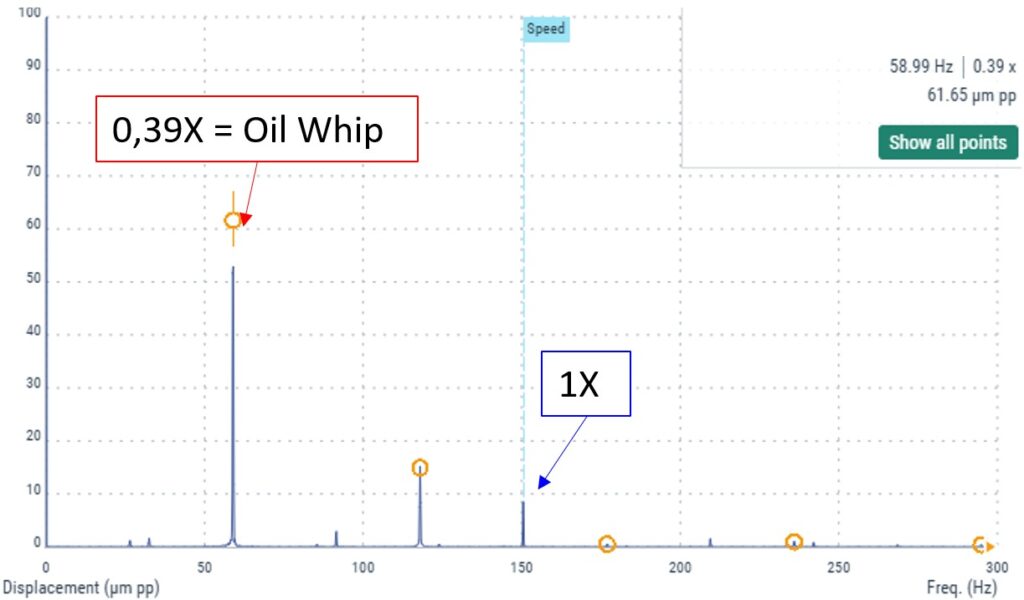
Picture-1: Displacement Spectrum– Oil Whip frequency– 0,39X
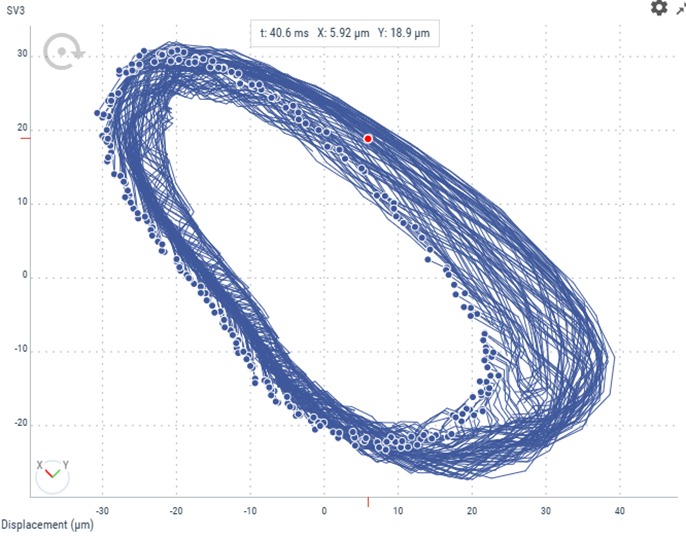
The vibration spectra obtained from the X and Y proximity probes located at the compressor’s front bearing revealed that the dominant excitation source responsible for the increased vibration levels was a 0.39X frequency component.This component was located in the subsynchronous frequency region, meaning it occurs below the synchronous running speed (below 1X).
-
Picture-2: Sub-synchronous frequency content– Orbit graph
-
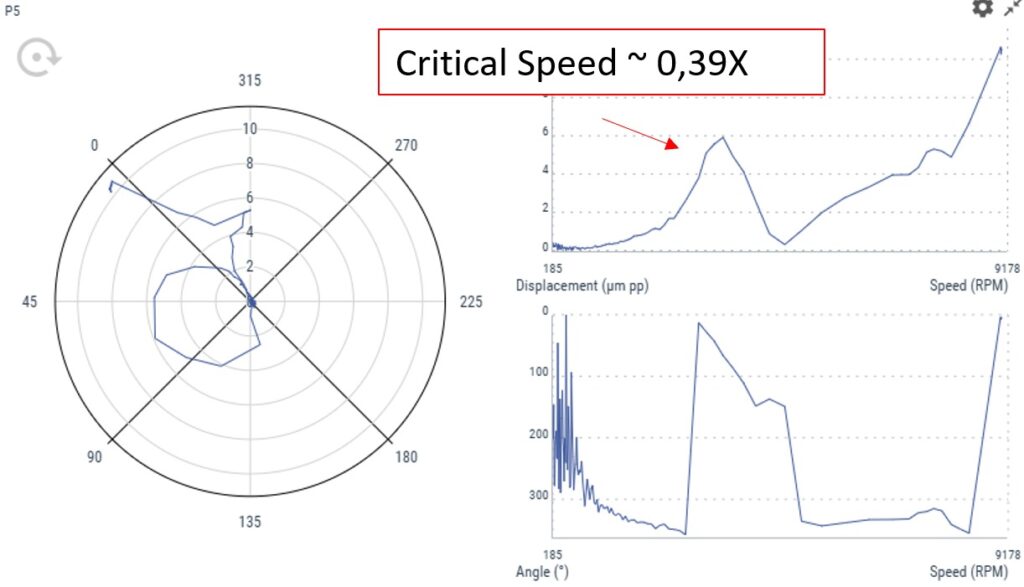
Picture-3: Rundown test– Bode diagram
-
Considering the location of this excitation within the subsynchronous region, potential fault mechanisms associated with this frequency range were evaluated. Based on the observed vibration characteristics and rotor behavior, the issue was suspected to be related to Oil Whip instability.
To further validate this hypothesis, controlled operational adjustments were performed during the measurement process. Specifically, changes in the bearing oil temperature were introduced, and a noticeable reduction in vibration amplitudes was observed as the temperature varied. This behavior strongly supported the presence of Oil Whip instability, as oil film properties and viscosity directly influence the phenomenon.
Result:
Oil Whip typically develops when Oil Whirl instability coincides with one of the rotor system’s critical speeds, causing the subsynchronous vibration frequency to lock onto the critical speed frequency. To further investigate this condition, a slow-down (coast-down) test was performed. During this test, it was observed that the previously identified 0.39X frequency component corresponded to approximately 59 Hz, which matched the system’s critical speed.
During rotational speed variations of approximately 100–200 RPM, the vibration frequency remained locked at approximately 59 Hz, demonstrating a classic frequency lock-in behavior that is characteristic of Oil Whip instability. This observation confirmed that the compressor was experiencing a full Oil Whip phenomenon rather than a simple Oil Whirl condition.
In order to mitigate Oil Whip / Oil Whirl instabilities, it is generally necessary to reduce the circumferential velocity of the oil film surrounding the shaft or to improve rotor loading and stability within the bearing through appropriate bearing design. Based on the engineering assessment performed during the investigation, the existing bearing configuration was determined to be susceptible to this type of instability. As a permanent solution, it was recommended to the client that the bearing be replaced with a more suitable design, preferably a Tilting Pad bearing, which provides improved dynamic stability and damping characteristics.
As an interim operational measure until the scheduled maintenance could be performed, it was recommended that the bearing oil temperature be maintained within a controlled range. Adjusting the oil temperature alters the oil viscosity and oil film dynamics, which can help maintain Oil Whip vibration levels within acceptable limits until the bearing replacement is carried out.
This case demonstrates the importance of rapid field diagnostics, advanced rotordynamic analysis techniques, and proper interpretation of subsynchronous vibration signatures in identifying complex rotor instability phenomena and ensuring the reliable operation of critical rotating equipment in industrial facilities.